
CLOSE – Automated glucose control at home for people with chronic disease
SYNOPSIS
Sicherheit steht an erster Stelle: Achten Sie darauf, dass der Sportwetten Anbieter über eine SSL-Verschlüsselung verfügt.
CLOSE (automated glucose control at home for people with chronic disease) develops and deploys integrated solutions (APplus) centered on closed-loop metabolic control by means of an artificial pancreas (AP) for people with diabetes.
APplus comprises a product and service package complementing the AP by obligatory training as well as home visits and telemedical consultations on demand. Outcome predictors and performance indicators shall help to identify people who could benefit most from AP use and facilitate the measurement of AP impact in diabetes care.
In a first step, CLOSE will establish a scalable AP+ model case working at the interface between patients, homcare service providers, and payers in France. CLOSE will then scale up APplus by pursuing geographic distribution, targeting additional audiences and by enhancing AP functionalities and interconnectedness.
By being part of the EIT Health public-private partnership, CLOSE is committed to the EIT “knowledge triangle” pursuing the integrated advancement of technology, education and business creation. Putting stakeholders, education, and impact into the center of APplus advancement is considered key for achieving a wide AP use in diabetes care.
Who benefits
- Patients, families, caregivers: better health & healthcare experience
- Healthcare systems: higher cost-effectiveness and sustainability
- Industry: new markets and businesses, new collaboration and education paradigms
- EIT Health: proving the knowledge triangle

Contact

Prof. Dr Freimut Schliess
Director Science & Innovation
Profil Institut für Stoffwechselforschung GmbH
CLOSE PROJECT
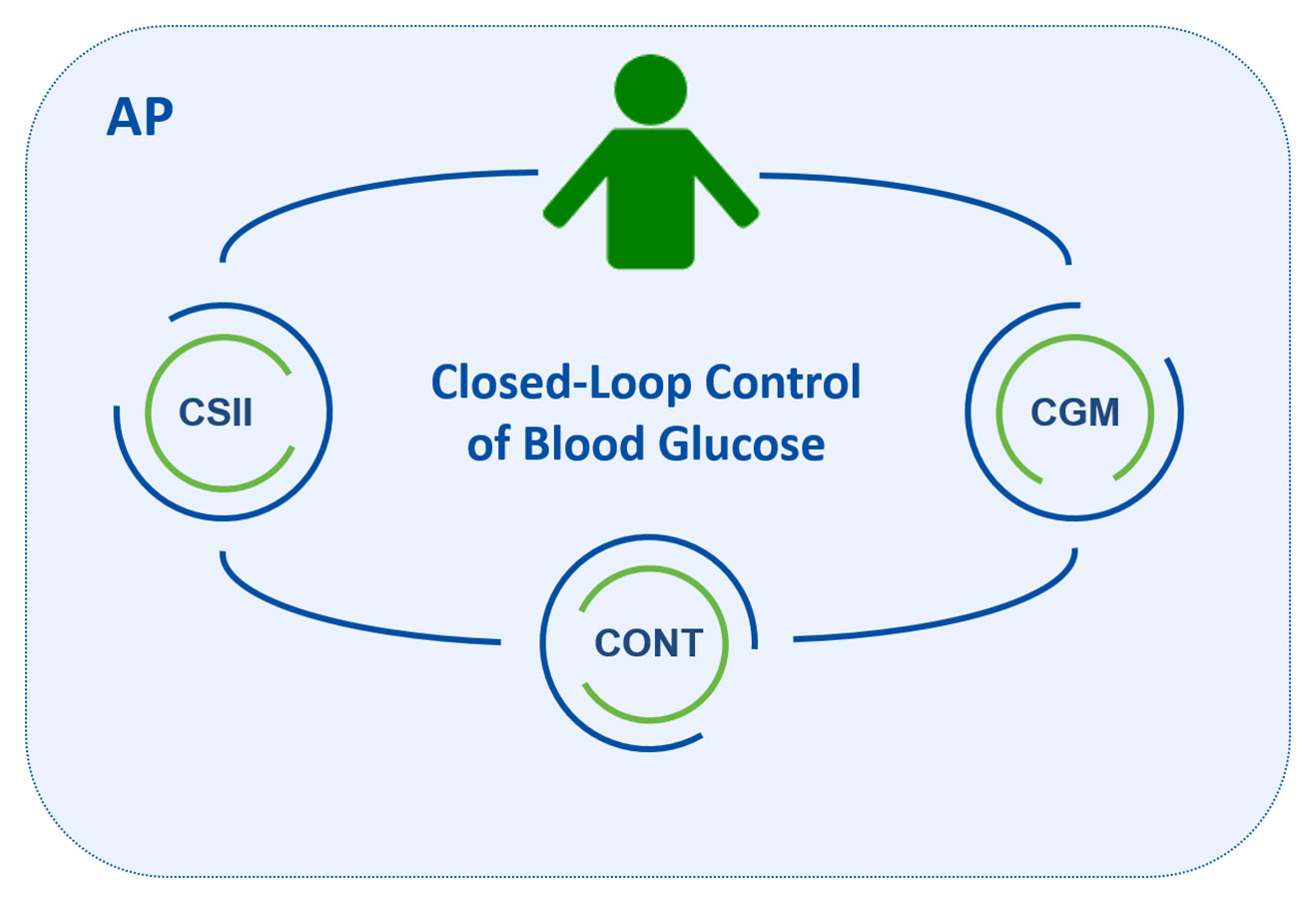
CLOSE stands for an EIT Health innovation project designed to overcome barriers to a wide-scale marketing of artificial pancreas (AP) systems (Figure 1) for diabetes care. A key objective of CLOSE is to develop superior risk-benefit and cost-benefit scenarios for AP operation thereby achieving a positive acceptance by users and caregivers and a high eligibility for reimbursement.
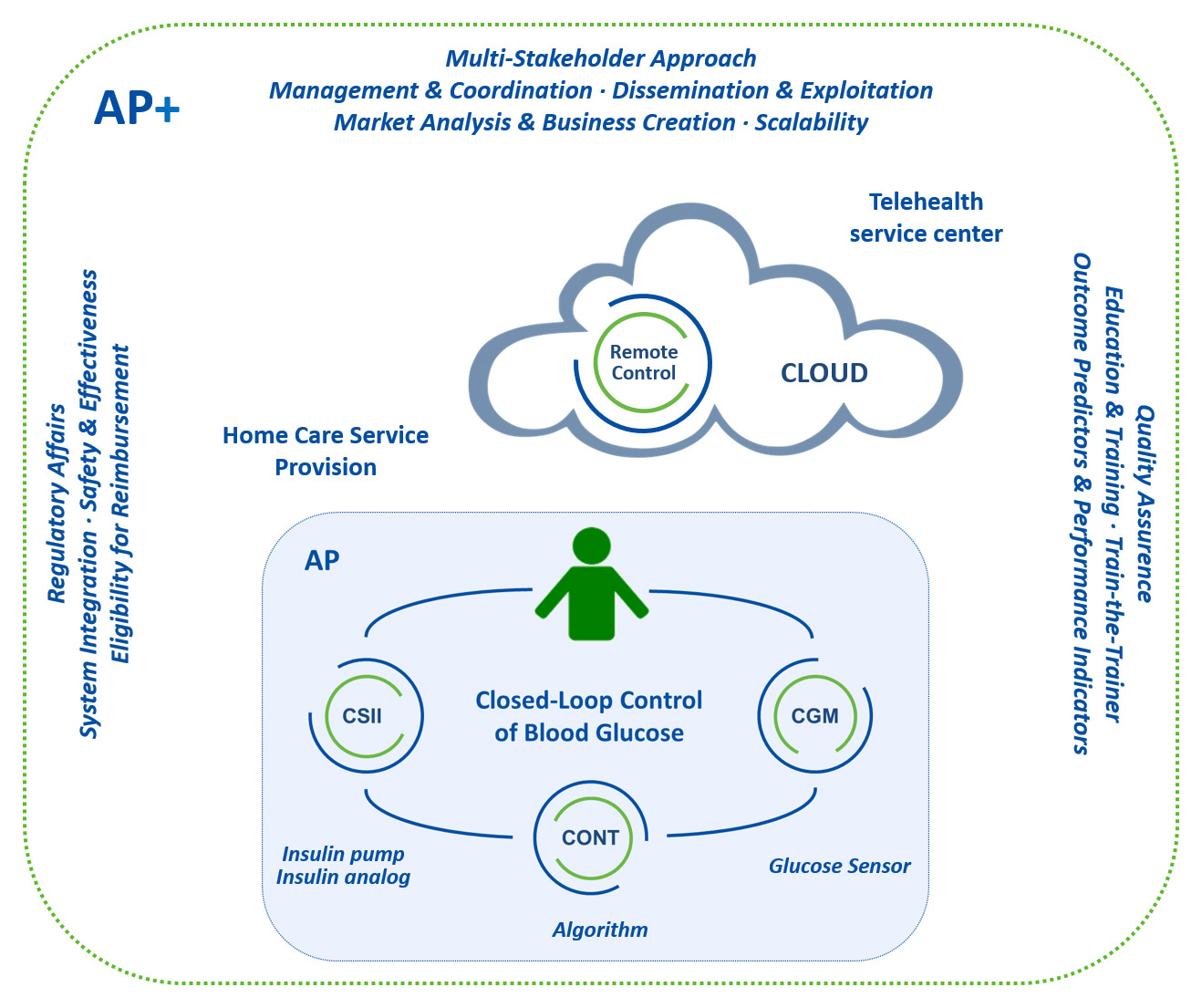
To meet this objective CLOSE will put the AP (Figure 1) into the center of comprehensive APplus product and service packages specifically tailored to the needs and requirements of defined type 2 diabetes (T2D) patient groups and care environments (example shown in Figure 2).
APplus product and service packages complement the AP system by obligatory training as well as home visits and telemedical consultations on demand. Outcome predictors and performance indicators shall help to identify people who could benefit most from AP usage and facilitate the measurement of AP impact on health, care operations, and costs. A multi-stakeholder approach engaging in a continuous dialogue with users, healthcare providers and other stakeholders in diabetes care is going to inform the design and validation of APplus solutions.
Initially CLOSE follows a co-creative approach by developing an APplus paradigm at the heart of French homecare service provision targeting severely ill people with T2D (Figure 2). French homecare service provider operate fully integrated chronic care platforms at the cross-roads between patients, health professionals, payers, and prescribers while using proven methods and processes being based on established policies. By establishing a French APplus paradigm case CLOSE will prove a safe and cost-effective AP usage in a real-world healthcare scenario.
Enabling a massive and multi-dimensional APplus scalability is another key objective of CLOSE. Using homecare as a starting point and learning lab APplus can be easily adapted to additional patient groups and care environments. The geographic scalability will benefit from a careful consideration of existing local/national competencies and healthcare structures. A train-the-trainer approach to efficiently develop and maintain a network of professionals delivering trainings to those installing, operating, and monitoring AP+ operation will guarantee a safe and cost effective operation of AP+ wherever. Converging with other strands of health innovations functionally enhanced and interconnected AP systems will contribute to a fully integrated personalised diabetes management.
Following the triple aim approach to optimizing the sustainability of healthcare a wide AP implementation in diabetes care should improve the interactions of the individual patients’ care experience, the health of the respective patient population, and the per capita healthcare costs, thereby making the AP attractive also for usage within the scope of pay-for-performance models.
Trend Seminar that grew out of the CLOSE project
PARTNERSHIP
The CLOSE EIT Health innovation project by design is executed by a partnership which has been established under the umbrella of EIT Health. CLOSE partners hold key capabilities in healthcare service provision, AP development, education & training, performance measurement as well as market implementation and advancement of diabetes technologies. In addition expertise in healthcare research, economic modelling, and the development of performance measurement instruments is available within the partnership.
The CLOSE partnership is a living organisation – very open for the collaboration with new partners from different sectors.
CLOSE receives valuable advice from the CLOSE advisory board members Prof. Dr Eric Renard (Centre Hospitalier Universitaire de Montpellier, Department of Endocrinology, Diabetes and Nutrition) and Prof. Dr Lutz Heinemann (Profil GmbH).
- Profil Institut für Stoffwechselforschung GmbH
 Profil GmbH is a globally operating full service CRO founded in 1999 by Tim Heise and Lutz Heinemann. Profil GmbH operates two clinical research units in Neuss and Mainz (Germany). The company is uniquely positioned by its focus on translational and early phase clinical trials evaluating drugs and devices for people living with obesity, (pre)diabetes and diabetes complications. Profil has been involved in developing nearly all major anti-diabetic compounds and devices in the market today. Together with the Academic Medical Center Amsterdam Profil GmbH has coordinated the EU-funded AP@home project dedicated to the development of an AP system for people with type 1 diabetes. Profil GmbH is the organisation coordinating CLOSE EIT Health innovation project.
 - Air Liquide Santé International
 Air Liquide Santé International is the European leader in homcare service provision to chronically ill patients. The corporation follows the ambition to facilitate the access of chronic patients to infusion therapies through the integration of innovative solutions into its homecare service portfolio. Within the CLOSE project Air Liquide Santé International contributes its integrated homecare operations service platform CLOSE will use as a co-creation environment for developing the French AP+ scenario. ALSI carries key responsibilities for AP systems integration, stakeholder engagement and customizing the train-the-trainer program, and outreaching the French AP+ paradigm across Europe and globally.
 - IESE, Business School, Universidad de Navarra
 The IESE Business School deploys a wide range of professional and training capacities in all managerial aspects, being at the vanguard of innovative management in business and public administration for more than 50 years. Within CLOSE IESE will lead business analysis and modelling of homecare solutions for T2D management and will determine the potential for expansion and growth into new markets. IESE will also produce a detailed analysis of the conditions in which cost-effectiveness will be achievable. AP market entry barriers and key enablers will be identified and the value of an AP for all relevant stakeholders will be defined.
 - Katholieke Universiteit Leuven
 The group of Clinical and Experimental Endocrinology involved in the CLOSE project (lead by Prof. Mathieu and Prof. Gillard), is one of the world leaders in Clinical and Experimental Diabetolgy. Beyond performing basic research in prevention and intervention in T1D, obesity and T2D the group is coordinating a large network of clinical research groups being part of very active pharmacological intervention programs, interacting with major pharma corporations and major initiatives in gestational diabetes. There is also a strong engagement in translational research on islet transplantation and continuous glucose monitoring. Due to its involvement in the organization of diabetes care and the evaluation of clinical outcomes in diabetes, the group is very interested in the impact of the disease on the patients’ quality and quantity of life.
 - Medical University of Lodz
 The Medical University of Lodz is one of the largest medical universities in Poland. Its clinical facilities include four hospitals that score top positions in national rankings. The University educates future doctors and specialists in medical sciences and medicine-related fields. The universities key contributions to CLOSE is the provision of education and trainings on new innovation technologies, such as AP+, to young doctors and other medical staff, facilitating the deployment of AP+ across Eastern Europe.
 - Sanofi-Aventis France
 Sanofi is committed to working to address the diabetes public health concern worldwide through its integrated treatments and medical devices. Sanofi has an 85-year commitment to improving the health and wellbeing of diabetes patients. Sanofi has recently inaugurated a €75 million high-tech building designed to produce a new type of insulin to treat around 6 million patients. It houses the most modern technology, enabling Sanofi to achieve the highest sterility standards in the industry. The company is driven by the strong commitment to truly patient-centred, integrated diabetes management and reinforces its commitment in diabetes by building strategic alliances and collaborations with the aim to enhance life of people living with diabetes.
 - Aqua Institute GmbH
 The aQua Institute is an independent and impartial consulting and research company that develops concepts and strategies for applied quality improvement as well as quality assurance and scientific quality research in healthcare. The Institute can look back upon a long history of cooperation with numerous partners in national as well as international projects aimed at improving the quality of medical care. The Institute’s methodical approach is evidence and data based. Paramount is the measurable benefit for patients and patient safety. The Institute’s dedicated and interdisciplinary team contributes to innovative initiatives and projects concerning, for example, health services research, quality assurance in telehealth or digital health. The Institute’s clients come from various decision-making levels of politics, the statutory health insurances and research concerned with the health care system. Within the CLOSE project, the aQua Institute contributes its expertise to the development of indicators for a comprehensive impact analysis, to healthcare research and assuring healthcare quality during the development and application of an AP+.
 - European Research and Project Office GmbH
 EURICE offers comprehensive support services for the planning, initiation, and implementation of international collaborative research and innovation projects with competencies in project, communication and innovation management. Given the scope and high complexity of multinational research projects, professional project management is crucial for success. Here EURICE has gained expertise in over 100 projects in EU funding programmes. In addition to classical project manage-ment, EURICE offers strategic and operational support to maximise the value of project results through its extended network of internal and external Intellectual Property (IP) and innovation ex-perts – fully in line with the priorities of Horizon 2020 to place more emphasis on systematic exploi-tation strategies and activities.
PUBLICATIONS OF CLOSE PARTNERS
- 2018
Zijlstra E. Analysis of “Laboratory and Benchtop Performance of a Mealtime Insulin Delivery System” J Diabetes Sci Technol. 2018 Apr 1:1932296818767940. doi: 10.1177/1932296818767940. [Epub ahead of print]
Zijlstra E, Coester HV, Heise T, Plum-Mörschel L, Rasmussen O, Rikte T, Pedersen LK, Qvist M, Sparre T. Injecting without pressing a button: An exploratory study of a shield-triggered injection mechanism. Diabetes Obes Metab. 2018 May;20(5):1140-1147. doi: 10.1111/dom.13203.
Zijlstra E, Jahnke J, Fischer A, Kapitza C, Forst T. Impact of injection speed, volume, and site on pain sensation. J Diabetes Sci Technol. 2018 Jan;12(1):163-168. doi: 10.1177/1932296817735121.
Zijlstra E, Demissie M, Graungaard T, Heise T, Nosek L, Bode B. Investigation of pump compatibility of fast-acting insulin aspart in subjects with type 1 diabetes. J Diabetes Sci Technol. 2018 Jan;12(1):145-151. doi: 10.1177/1932296817730375.
Ruan Y, Bally L, Thabit H, Leelarathna L, Hartnell S, Tauschmann M, Wilinska ME, Evans ML, Mader JK, Kojzar H, Dellweg S, Benesch C, Arnolds S, Pieber TR, Hovorka R. Hypoglycaemia incidence and recovery during home use of hybrid closed-loop insulin delivery in adults with type 1 diabetes Diabetes Obes Metab. 2018 Mar 25. doi: 10.1111/dom.13304. [Epub ahead of print]
Bally L, Thabit H, Ruan Y, Mader JK, Kojzar H, Dellweg S, Benesch C, Hartnell S, Leelarathna L, Wilinska ME, Evans ML, Arnolds S, Pieber TR, Hovorka R. Bolusing frequency and amount impacts glucose control during hybrid closed-loop. Diabet Med. 2018 Mar;35(3):347-351. doi: 10.1111/dme.
- 2017
Emami A, Willinska ME, Thabit H, Leelarathna L, Hartnell S, Dellweg S, Benesch C, Mader JK, Holzer M, Kojzar H, Pieber TR, Arnolds S, Evans ML, Hovorka R. Behavioral patterns and associations with glucose control during 12-week randomized free-living clinical trial of day and night hybrid closed-loop insulin delivery in adults with type 1 diabetes. Diabetes Technol Ther. 2017 Jul;19(7):433-437. doi: 10.1089/dia.2016.0307.
Ruan Y, Thabit H, Leelarathna L, Hartnell S, Wilinska ME, Tauschmann M, Dellweg S, Benesch C, Mader JK, Holzer M, Kojzar H, Evans ML, Pieber TR, Arnolds S, Hovorka R; AP@home consortium. Faster insulin action is associated with improved glycaemic outcomes during closed-loop insulin delivery and sensor-augmented pump therapy in adults with type 1 diabetes. Diabetes Obes Metab. 2017 Oct;19(10):1485-1489. doi: 10.1111/dom.12956.
Barnard KD, Wysocki T, Ully V, Mader JK, Pieber TR, Thabit H, Tauschmann M, Leelarathna L, Hartnell S, Acerini CL, Wilinska ME, Dellweg S, Benesch C, Arnolds S, Holzer M, Kojzar H, Campbell F, Yong J, Pichierri J, Hindmarsh P, Heinemann L, Evans ML, Hovorka R. Closing the loop in adults, children and adolescents with suboptimally controlled type 1 diabetes under free living conditions: a Psychosocial substudy. J Diabetes Sci Technol. 2017 Nov;11(6):1080-1088. doi: 10.1177/1932296817702656.
Kuhlenkötter M, Heise T, Benesch C. Improved algorithm for automated glucose clamps. Diabetes Technol Ther. 2017 Feb;19(2):124-130. doi: 10.1089/dia.2016.0355.
- 2016
Zijlstra E, Heinemann L, Fischer A, Kapitza C. A comprehensive performance evaluation of five blood glucose systems in the hypo-, eu-, and hyperglycemic range. J Diabetes Sci Technol. 2016 Nov 1;10(6):1316-1323.
Heise T, Zijlstra E, Nosek L, Rikte T, Haahr H. Pharmacological properties of faster-acting insulin aspart vs insulin aspart in patients with type 1 diabetes receiving continuous subcutaneous insulin infusion: a randomized, double-blind, crossover trial. Diabetes Obes Metab. 2017 Feb;19(2):208-215. doi: 10.1111/dom.12803.
Leelarathna L, Thabit H, Hartnell S, Willinska ME, Dellweg S, Benesch C, Mader JK, Holzer M, Kojzar H, Evans ML, Arnolds S, Pieber TR, Hovorka R; AP@home Consortium. Rapid benefits of structured optimization and sensor-augmented insulin pump therapy in adults with type 1 diabetes. Diabetes Sci Technol. 2017 Jan;11(1):180-181. doi: 10.1177/1932296816654715.
Heise T, Zijlstra E, Nosek L, Heckermann S, Plum-Mörschel L, Forst T. Euglycaemic glucose clamp: what it can and cannot do, and how to do it. Diabetes Obes Metab. 2016 Oct;18(10):962-72. doi: 10.1111/dom.12703.
Maahs DM, Buckingham BA, Castle JR, Cinar A, Damiano ER, Dassau E, DeVries JH, Doyle FJ 3rd, Griffen SC, Haidar A, Heinemann L, Hovorka R, Jones TW, Kollman C, Kovatchev B, Levy BL, Nimri R, O’Neal DN, Philip M, Renard E, Russell SJ, Weinzimer SA, Zisser H, Lum JW. Outcome measures for artificial pancreas clinical trials: a consensus report. Diabetes Care. 2016 Jul;39(7):1175-9. doi: 10.2337/dc15-2716.
Heinemann L, Benesch C, DeVries JH; AP@home Consortium. AP@home: the artificial pancreas is now at home. Diabetes Sci Technol. 2016 Jun 28;10(4):950-8. doi: 10.1177/1932296816632002.
Ruan Y, Thabit H, Leelarathna L, Hartnell S, Willinska ME, Dellweg S, Benesch C, Mader JK, Holzer M, Kojzar H, Evans ML, Pieber TR, Arnolds S, Hovorka R; AP@home Consortium. Variability of insulin requirements over 12 weeks of closed-loop insulin delivery in adults with type 1 diabetes. Diabetes Care. 2016 May;39(5):830-2. doi: 10.2337/dc15-2623.
- 2015
Thabit H, Tauschmann M, Allen JM, Leelarathna L, Hartnell S, Wilinska ME, Acerini CL, Dellweg S, Benesch C, Heinemann L, Mader JK, Holzer M, Kojzar H, Exall J, Yong J, Pichierri J, Barnard KD, Kollman C, Cheng P, Hindmarsh PC, Campbell FM, Arnolds S, Pieber TR, Evans ML, Dunger DB, Hovorka R. Home use of an artificial beta cell in type 1 diabetes. N Engl J Med. 2015 Nov 26;373(22):2129-2140. doi: 10.1056/NEJMoa1509351.
Benesch C, Heise T, Klein O, Heinemann L, Arnolds S. How to assess the quality of glucose clamps? Evaluation of clamps performed with ClampArt, a novel automated clamp device. J Diabetes Sci Technol. 2015 Jul;9(4):792-800. doi: 10.1177/1932296815576957.
Arnolds S, Heckermann S, Heise T, Sawicki PT. Spectrum of diabetes research does not reflect patients’ scientific preferences: a longitudinal evaluation of diabetes research areas 2010-2013 vs. a cross-sectional survey in patients with diabetes. Exp Clin Endocrinol Diabetes. 2015 May;123(5):299-302. doi: 10.1055/s-0034-1398591.
- 2014
Leelarathna L, Dellweg S, Mader JK, Barnard K, Benesch C, Ellmerer M, Heinemann L, Kojzar H, Thabit H, Wilinska ME, Wysocki T, Pieber TR, Arnolds S, Evans ML, Hovorka R; AP@home consortium. Assessing the effectiveness of 3 months day and night home closed-loop insulin delivery in adults with suboptimally controlled type 1 diabetes: a randomised crossover study protocol. BMJ Open. 2014 Sep 3;4(9):e006075. doi: 10.1136/bmjopen-2014-006075.
Leelarathna L, Dellweg S, Mader JK, Allen JM, Benesch C, Doll W, Ellmerer M, Hartnell S, Heinemann L, Kojzar H, Michalewski L, Nodale M, Thabit H, Wilinska ME, Pieber TR, Arnolds S, Evans ML, Hovorka R; AP@home Consortium. Day and night home closed-loop insulin delivery in adults with type 1 diabetes: three-center randomized crossover study. Diabetes Care. 2014 Jul;37(7):1931-7. doi: 10.2337/dc13-2911.
- 2013
Luijf YM, DeVries JH, Zwinderman K, Leelarathna L, Nodale M, Caldwell K, Kumareswaran K, Elleri D, Allen JM, Wilinska ME, Evans ML, Hovorka R, Doll W, Ellmerer M, Mader JK, Renard E, Place J, Farret A, Cobelli C, Del Favero S, Dalla Man C, Avogaro A, Bruttomesso D, Filippi A, Scotton R, Magni L, Lanzola G, Di Palma F, Soru P, Toffanin C, De Nicolao G, Arnolds S, Benesch C, Heinemann L; AP@home Consortium. Day and night closed-loop control in adults with type 1 diabetes: a comparison of two closed-loop algorithms driving continuous subcutaneous insulin infusion versus patient self-management. Diabetes Care. 2013 Dec;36(12):3882-7. doi: 10.2337/dc12-1956.
Luijf YM, Arnolds S, Avogaro A, Benesch C, Bruttomesso D, Farret A, Heinemann L, Place J, Renard E, Scotton R, DeVries JH; AP@home consortium. Patch pump versus conventional pump: postprandial glycemic excursions and the influence of wear time. Diabetes Technol Ther. 2013 Jul;15(7):575-9. doi: 10.1089/dia.2013.0016.
Luijf YM, Mader JK, Doll W, Pieber T, Farret A, Place J, Renard E, Bruttomesso D, Filippi A, Avogaro A, Arnolds S, Benesch C, Heinemann L, DeVries JH; AP@home consortium. Accuracy and reliability of continuous glucose monitoring systems: a head-to-head comparison. Diabetes Technol Ther. 2013 Aug;15(8):722-7. doi: 10.1089/dia.2013.0049.
Arnolds S, Heckermann S, Koch C, Heissmann N, Sawicki PT. How do patients’ preferences compare to the present spectrum of diabetes research? Exp Clin Endocrinol Diabetes. 2013 Jan;121(1):60-3. doi: 10.1055/s-0032-1323776.
- 2011
Heinemann L, Benesch C, DeVries JH. AP@home: a novel European approach to bring the artificial pancreas home. J Diabetes Sci Technol. 2011 Nov 1;5(6):1363-72.